
The Universal In-Roof Mounting System
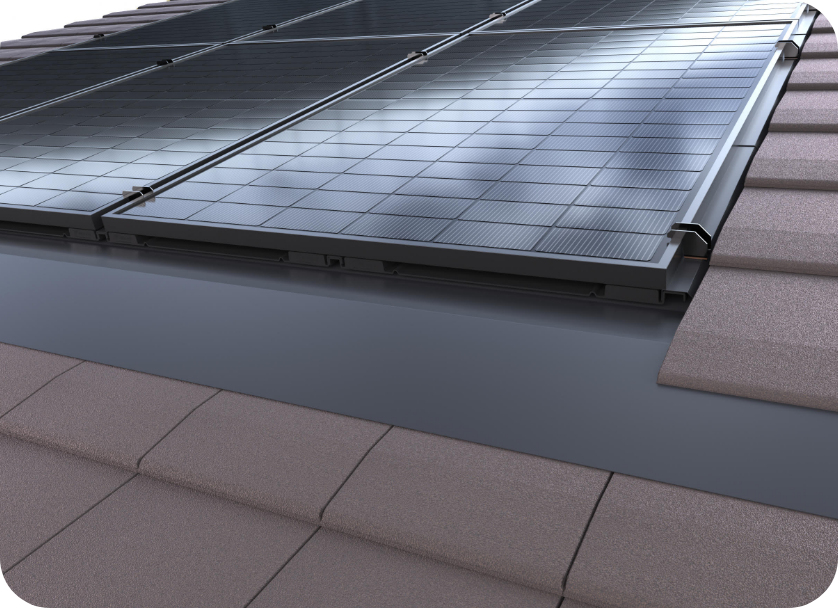
Advanced in-roof photovoltaic mounting system designed to combine architectural integration, structural performance and long-term sustainability.
It goes far beyond a standard mounting tray by delivering a fully engineered and scalable solution, supported by independent testing, certification and technical assessment across the markets in which it is supplied.
A truly universal in-roof system
A wide range of current photovoltaic panel sizes,
Future panel formats within the system’s dimensional capabilities,
Both portrait and landscape installations.
A simplified system architecture across projects,
Simplified design and installation,
Flexibility to accommodate the evolution of photovoltaic module formats.
COMPATIBILITY WITH LEADING PHOTOVOLTAIC PANEL MANUFACTURERS
Thanks to its universal and flexible design, S4 Roofit is designed to accommodate a wide range of photovoltaic panel sizes and configurations, including panels supplied by leading international manufacturers.
These manufacturers rely on proven industrial processes, combining highly qualified production lines, rigorous quality controls and internationally recognised certifications.
When combined with panels from these established manufacturers, S4 Roofit provides a coherent and robust solution designed to meet demanding expectations in terms of quality and long-term performance.
Compatibility of a photovoltaic module with the S4 Roofit system does not, in itself, mean that the module is covered by a specific certification, technical assessment or fire classification. The applicable certification and assessment documentation for the relevant country should be consulted to confirm the scope of coverage for the module, market and intended application.
Engineered for strength and durability
- Pressure loads,
- Wind uplift (depression),
- Long-term structural stress.
CERTIFIED, ASSESSED AND COMPLIANT
S4 Roofit follows a certification and technical assessment approach adapted to the different markets in which the system is supplied, in accordance with applicable local standards and requirements.
Depending on the country and application, the system may be subject to specific certifications, technical assessments, testing and classifications, covering areas including:
- Mechanical and structural performance,
- Weathertightness and resistance to weather conditions,
- Fire performance,
- Applicable local regulatory and technical requirements.
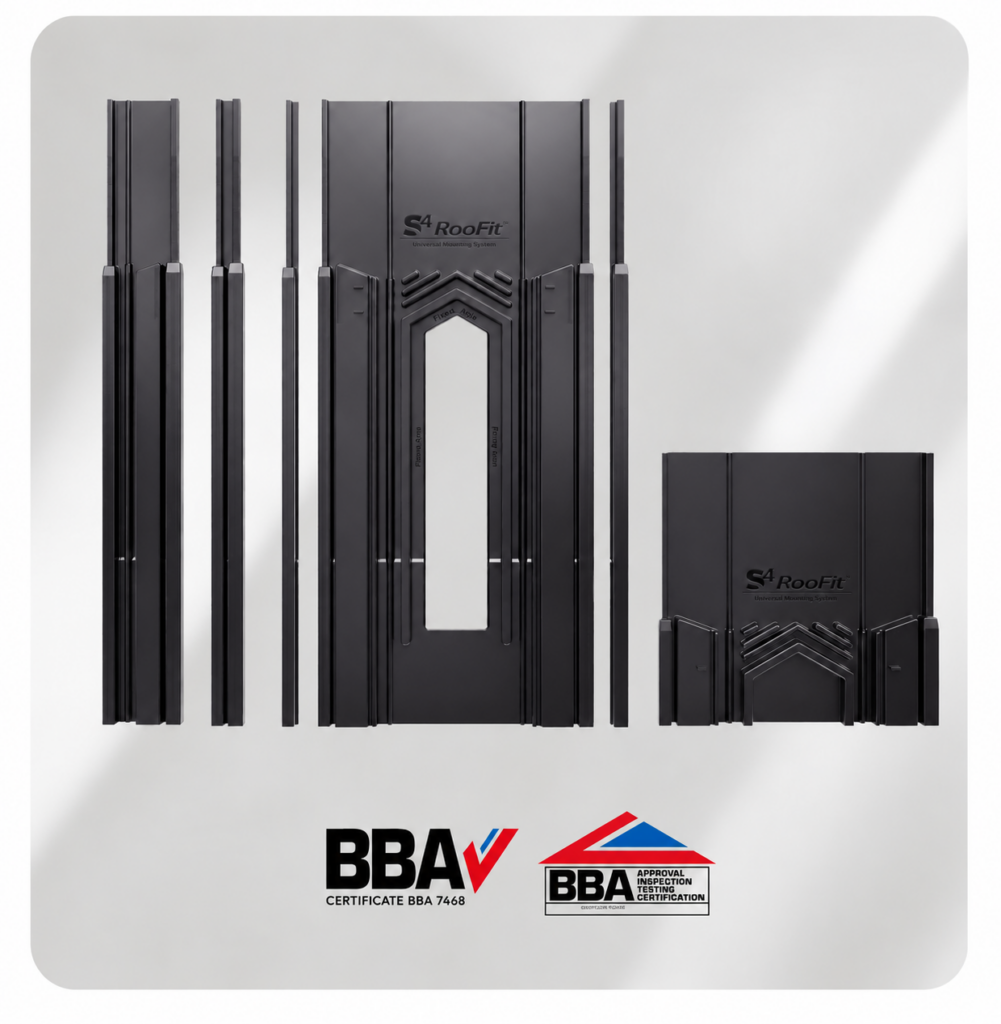
For the UK market, S4 Roofit is supported by BBA certification and assessment, within the specific scopes defined by the applicable certification documentation.
The scope of certifications, assessments and classifications may vary depending on the country, system configuration, photovoltaic module and intended application. The relevant documentation for the applicable market should always be consulted to confirm the scope of coverage.

CERTIFIED, ASSESSED AND COMPLIANT
S4 Roofit follows a certification and technical assessment approach adapted to the different markets in which the system is supplied, in accordance with applicable local standards and requirements.
Depending on the country and application, the system may be subject to specific certifications, technical assessments, testing and classifications, covering areas including:
• Mechanical and structural performance,
• Weathertightness and resistance to weather conditions,
• Fire performance,
• Applicable local regulatory and technical requirements.
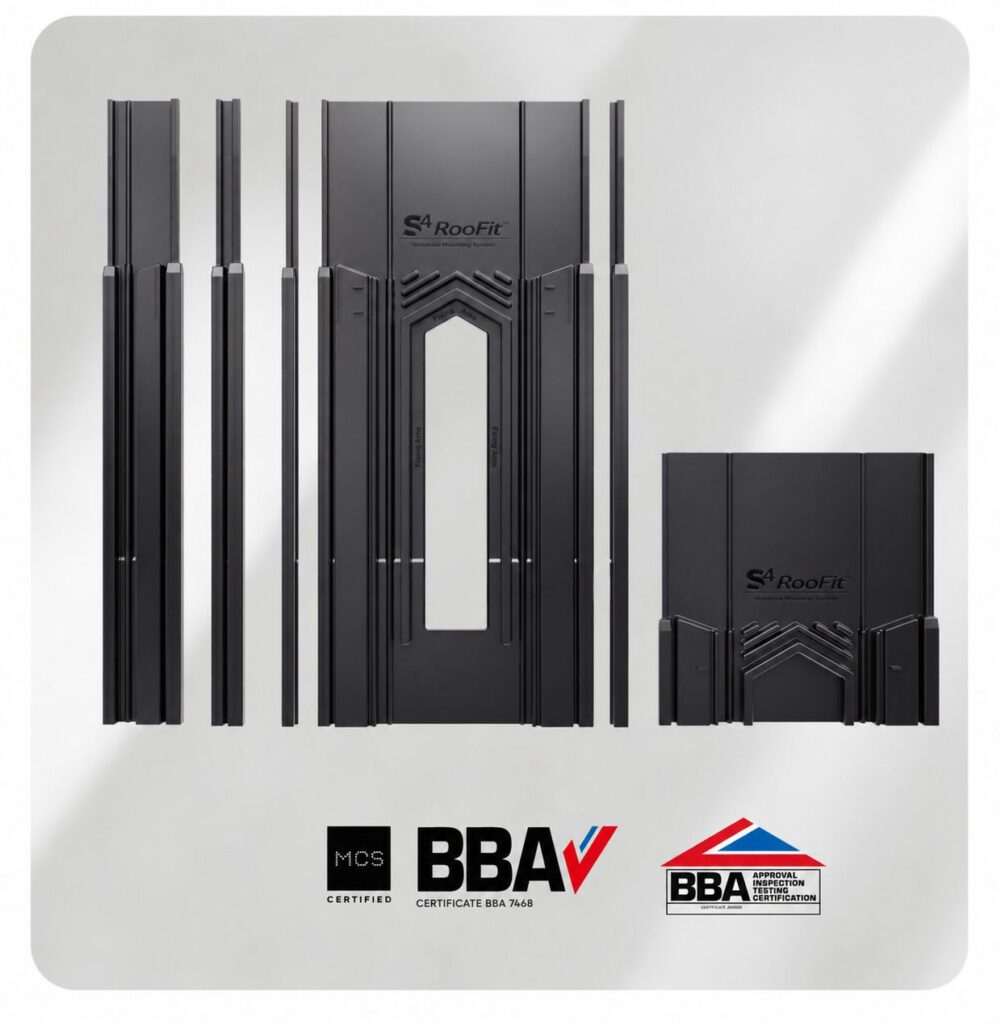
For the UK market, S4 Roofit is supported by MCS 012 certification and BBA assessment, within the specific scopes defined by the applicable certification documentation.
The scope of certifications, assessments and classifications may vary depending on the country, system configuration, photovoltaic module and intended application. The relevant documentation for the applicable market should always be consulted to confirm the scope of coverage.
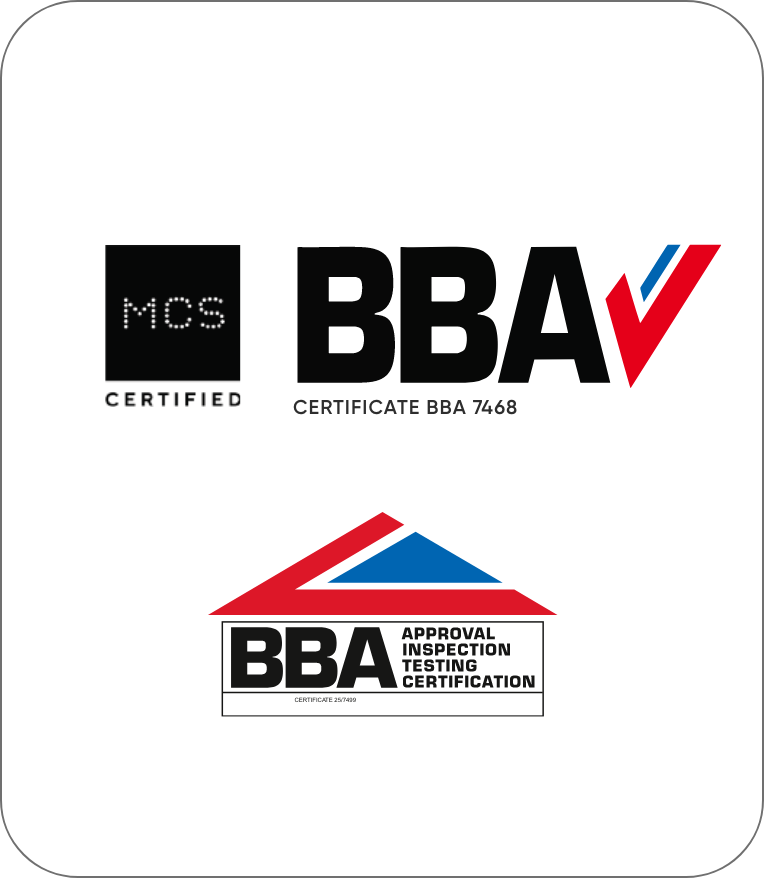
Industrial efficiency with local focus
- Controlled tooling investment,
- Local production where required,
- Reduced transport distances,
- Faster delivery times.
- Lower logistics impact,
- Improved supply chain resilience,
- Reduced environmental footprint.

Simplified installation & inventory
- One system designed to accommodate a wide range of panel sizes
- No distinction between portrait and landscape kits,
- Reduced SKU count,
- Faster installation,
- Simplified stock management.
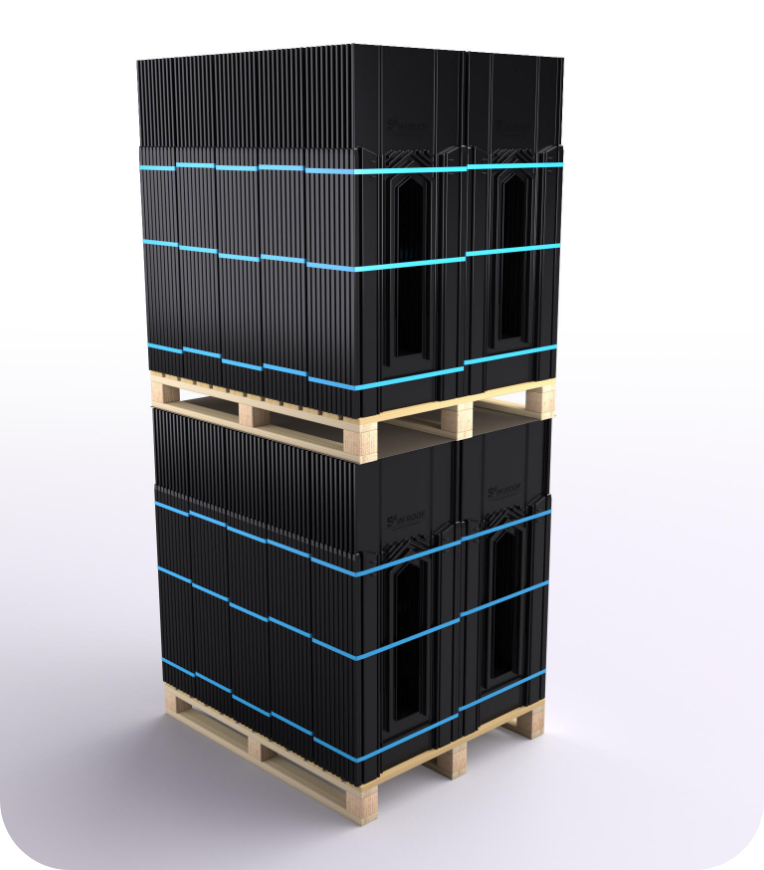
Different Design Approaches Explained
The UK in-roof photovoltaic market includes several system design approaches.
Understanding these differences is essential for house builders, designers and procurement teams when assessing long-term performance, compliance and supply chain resilience.
The comparison below outlines key distinctions between proprietary panel-based in-roof systems and universal in-roof mounting platforms, to support informed specification decisions.
Comparison of System Design Approaches
| Criteria | Proprietary panel-based systems | S4 Roofit – Universal In-Roof System |
|---|---|---|
| System architecture | Designed around specific photovoltaic panels | Universal, panel-agnostic mounting platform |
| PV module selection | Typically defined around a specified panel range | Compatible with panels from major global manufacturers |
| Certification structure | Panel-dependent validation | Single system certification ,framework |
| Adaptation to future panels | May require additional validation depending on the system and module | Designed to accommodate future panel formats |
| Installation methodology | Panel-specific processes | Standardised, repeatable installation |
| Component complexity | Multiple product-specific components | Reduced component architecture |
| Stock management | Multiple SKUs | Single-reference system approach |
| Supply chain dependency | Tied to specific panel suppliers | Open and flexible supply chain |
| Long-term availability | Linked to panel lifecycle | Independent from panel lifecycle |
System-Level Safety & Compliance Approach
“Fire performance, electrical safety and system integrity are addressed through a system-level approach incorporating appropriate testing, technical assessment and applicable certification requirements.”
This system-level approach is intended to address safety, performance and compliance through integrated system design, testing and technical assessment.
System-Level Safety & Compliance Approach
“Fire performance, electrical safety and system integrity are addressed at system level through
independent certification frameworks, rather than through the addition of isolated components.”
This system-level approach avoids reliance on add-on mitigation products by addressing safety,
performance and compliance through certified system design.
Design Philosophy
Proprietary in-roof systems are typically developed around a specific photovoltaic panel range.
While this approach can offer integration simplicity, it may also introduce long-term dependency on individual panel suppliers and product lifecycles.
Universal in-roof platforms, such as S4 Roofit, are engineered independently from the photovoltaic panels themselves.
This approach allows integration with leading global panel manufacturers operating highly industrialised, certified and continuously evolving production processes.
As a result, the system benefits from:
- access to panels produced at the highest industrial standards,
- continuity of supply,
- long-term compatibility with market evolution.
System Architecture & Component Strategy
- The industrial quality of photovoltaic modules,
- Compliance with international standards (IEC 61215 / IEC 61730),
- Consistent manufacturing processes,
- And a robust, system-level integration approach.
This approach supports:
This approach ensures:
- Consistent electrical and mechanical quality,
- Traceable manufacturing processes,
- Long-term product availability,
- Alignment with international certification frameworks.
Certification & Regulatory Alignment
- BBA assessed, confirming compliance with NHBC Standards
- system robustness,
- regulatory compliance,
- suitability for UK housebuilders and large-scale residential deployment.
- MCS 012 certified
- BBA assessed, confirming compliance with NHBC Standards
- system robustness,
- regulatory compliance,
- suitability for UK housebuilders and large-scale residential deployment.
Summary
Different in-roof photovoltaic solutions reflect different design philosophies.
S4 Roofit has been developed as a universal, certified and future-proof in-roof system, offering housebuilders a robust alternative to panel-specific solutions, while maintaining flexibility, regulatory alignment and long-term supply chain resilience.
The system architecture of S4 Roofit is the result of long-term market observation and practical experience in building-integrated photovoltaics.
France was among the earliest European markets to adopt Building-Integrated Photovoltaics (BIPV) at scale.
This early adoption generated valuable long-term feedback on system behaviour, durability and roof integration over time.
Early-generation BIPV systems highlighted several key industry challenges, including installation complexity, long-term watertightness, maintenance requirements and reliance on proprietary components.
They also underlined the importance of system architectures capable of maintaining roof watertightness even in the event of a localised module failure, such as a damaged or broken panel.
These market learnings have played a significant role in shaping the evolution of in-roof photovoltaic design standards across Europe.
S4’s system architecture directly builds on this accumulated experience, adopting a second-generation approach focused on system robustness, simplified installation, long-term compatibility and regulatory continuity.
The design philosophy of S4 Roofit prioritises a watertightness strategy that is independent of the photovoltaic module itself, ensuring continued building protection during maintenance, replacement or in the event of module failure.
This experience-led development philosophy underpins S4’s positioning and supports its suitability for large-scale residential deployment.
This comparison is provided for informational purposes only and reflects general system design approaches observed in the UK in-roof photovoltaic market. It does not constitute a claim regarding the performance or compliance of any specific third-party product.
MCS 012 Issue 3 – BROOF(t4) Fire Testing Requirements
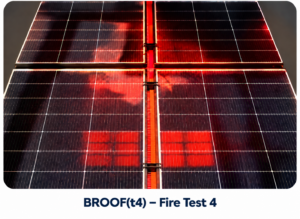 Effective from May 2025, following a two-year transition period granted to manufacturers, MCS 012 Issue 3 introduced enhanced fire safety requirements for in-roof photovoltaic systems.
These requirements specifically address the assessment of fire performance at the joints and gaps between adjacent photovoltaic modules.
A BROOF(t4) test conducted on a single photovoltaic module does not, on its own, demonstrate compliance with the intermodule joint requirements of MCS 012 Issue 3. These interfaces must be covered by appropriate testing or technical assessment.
Since its inception, S4 Mounting System has maintained a rigorous and systematic approach to regulatory compliance, anticipating changes in standards and ensuring that its systems undergo independent testing by accredited laboratories.
S4 has therefore conducted its BROOF(t4) fire tests using configurations comprising two and four photovoltaic modules, allowing the joints and interfaces between panels to be directly assessed under conditions representative of real-world installations.
This approach reflects S4’s ongoing commitment to safety, regulatory compliance and the long-term reliability of its systems.
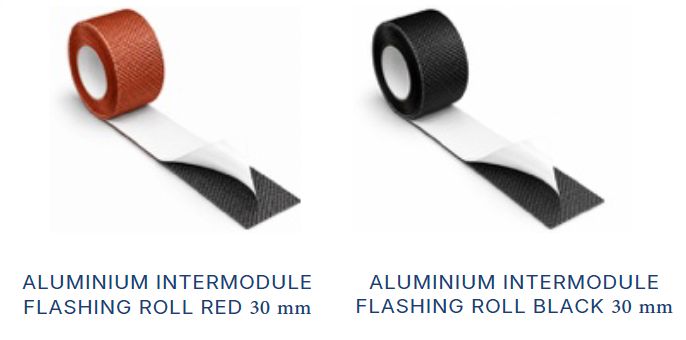
Available in red and black, the aluminium strip can be easily cut with scissors or a utility knife. Thanks to its self-adhesive butyl backing, it can be positioned and secured in just a few minutes.

UK Technical Requirements
IMPORTANT MCS 012 Issue 3 – BROOF(t4) Fire Classification
The S4 Roofit system must be installed in accordance with the manufacturer’s installation manual and the configurations covered by the applicable certification.
The S4 aluminium intermodule is an integral component of the system’s BROOF(t4) fire-tested configuration and is specified in the S4 Roofit installation instructions.
Although the intermodule does not serve a waterproofing function, its installation is required to reproduce the configuration covered by the applicable fire classification.
Installers must ensure that the intermodule is correctly fitted in accordance with the installation instructions.
To support consistent installation practices, S4 Mounting System continues to provide technical documentation, installation guidance and dedicated training programmes.
The installation instructions have also been harmonised across European markets to promote a consistent approach to system installation.
IMPORTANT:
All S4 Roofit installations must comply with the latest applicable installation manual, including the use of all specified mandatory components.
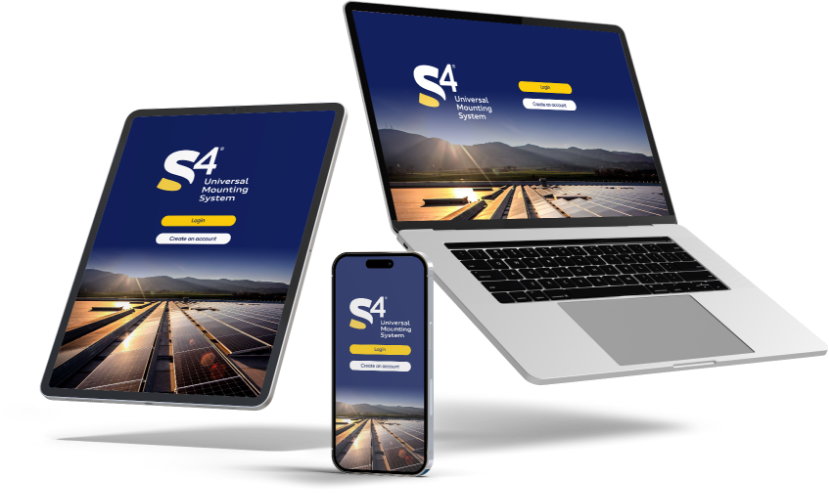
A platform built for compliance, accuracy, and reliability
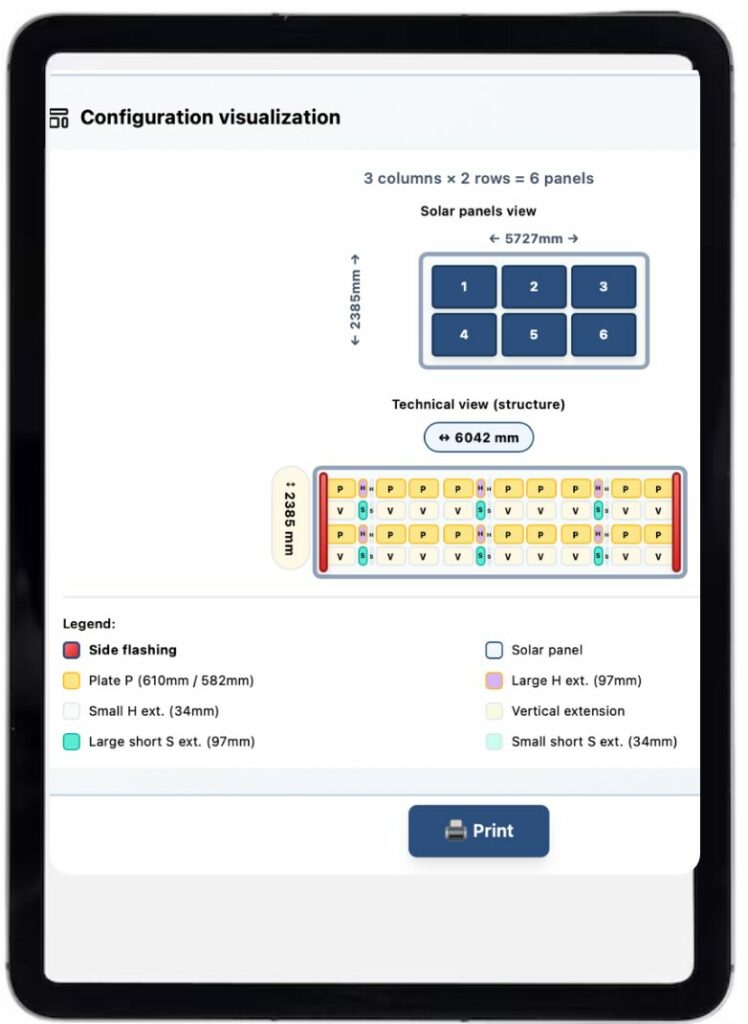
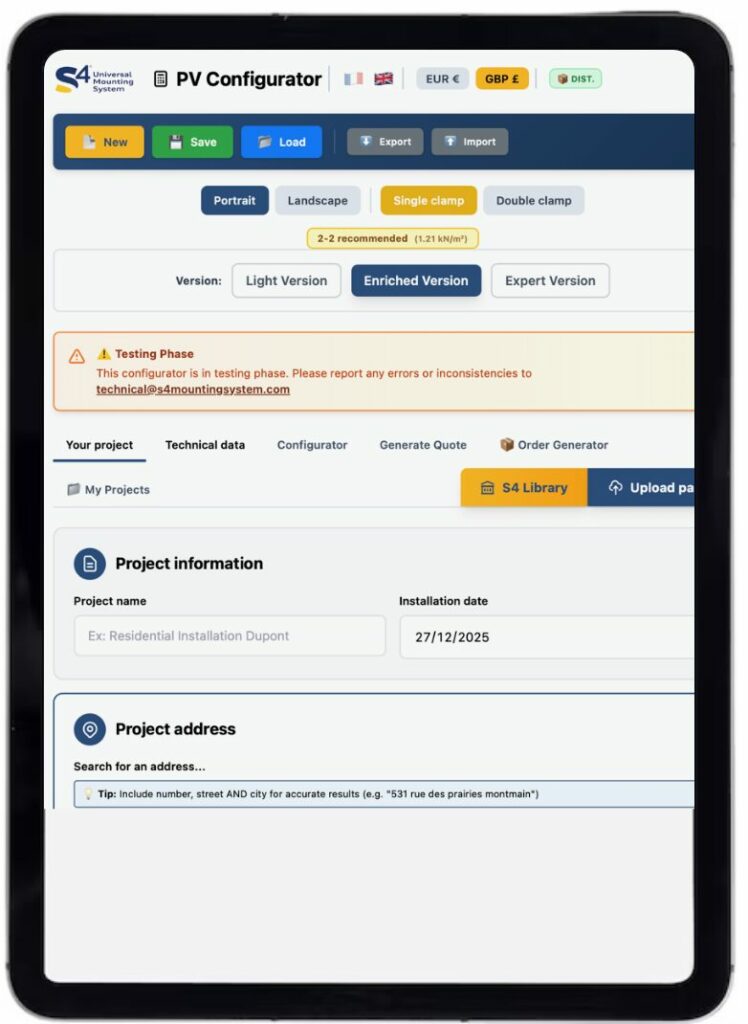
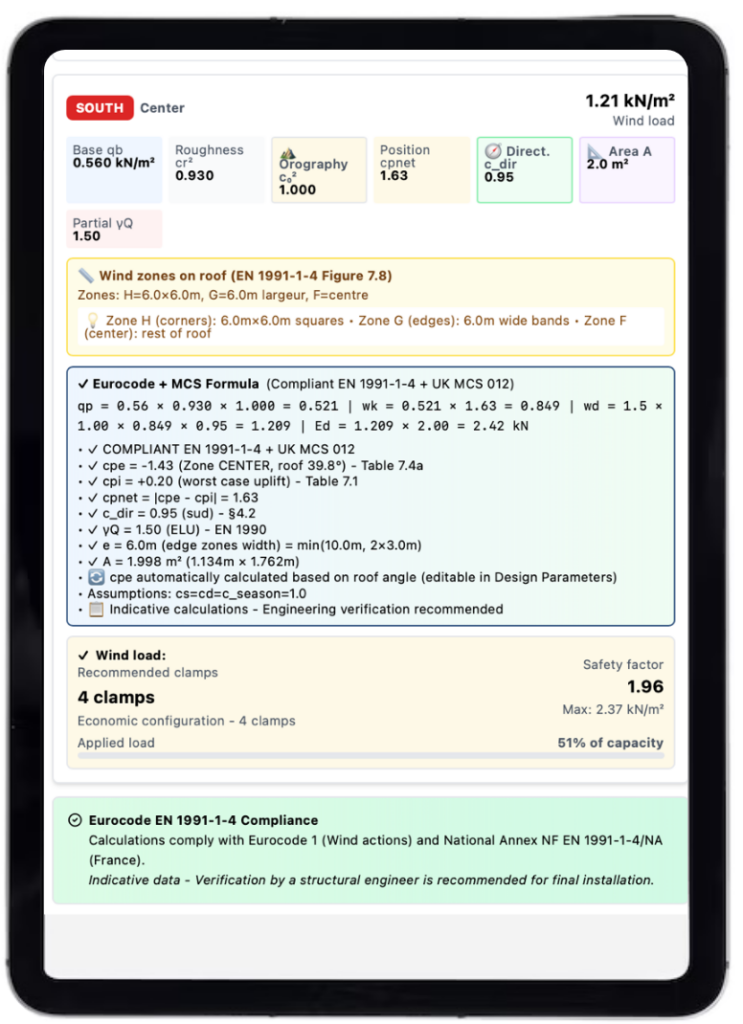
The S4 Configurator has been developed as a central component of the S4 ecosystem, supporting the design, validation and deployment of photovoltaic systems in accordance with applicable technical and regulatory requirements.
More than just a configuration tool, it is a decision-support platform designed to secure projects from the very first stages of planning.
Built to recognized standards
and regulations
- European Eurocodes and national annexes,
- Relevant British Standards (BS),
- Applicable structural and engineering requirements,
- Technical requirements relevant to UK new-build housing.
- European Eurocodes and national annexes,
- Relevant British Standards (BS),
- MCS 012 requirements,
- NHBC expectations for new-build housing.
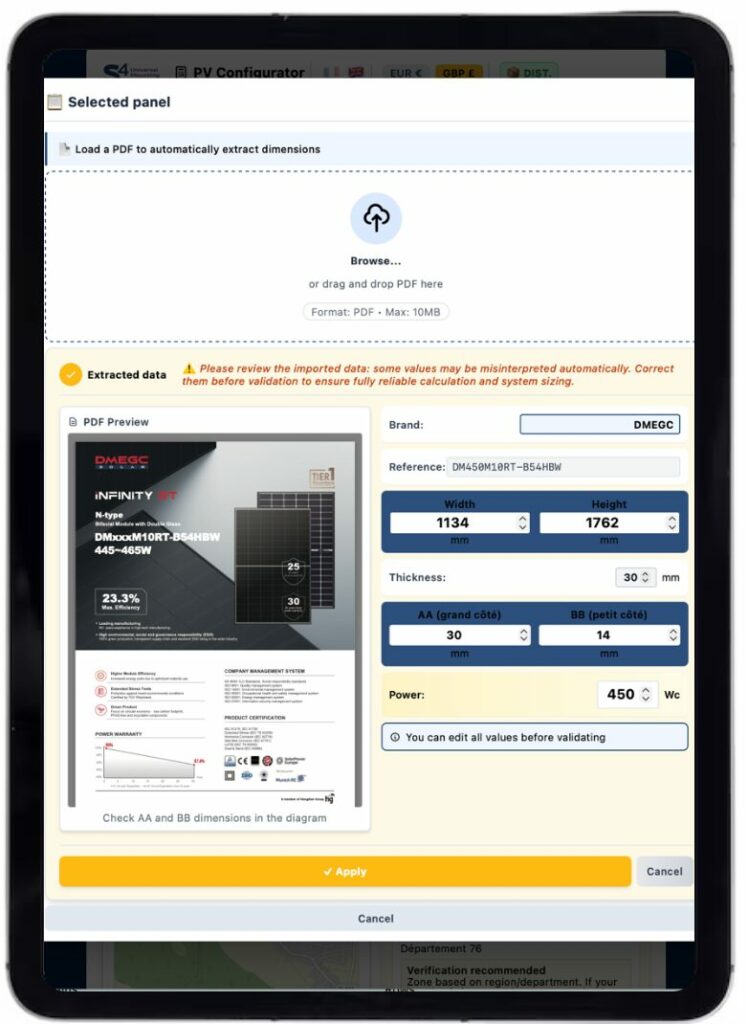
Extensive module database
- Exact physical dimensions and tolerances,
- Frame geometries,
- Fixing interface characteristics,
- Manufacturer-specific constraints.
Designed for real-world
installation conditions
- Portrait and landscape layouts,
- Variable roof geometries and pitches,
- Different fixing strategies and overlap zones,
- Compatibility with roof coverings and drainage principles.